Agents That Quietly Drift: Building Step-Level Reliability Into Multi-Step LLM Workflows
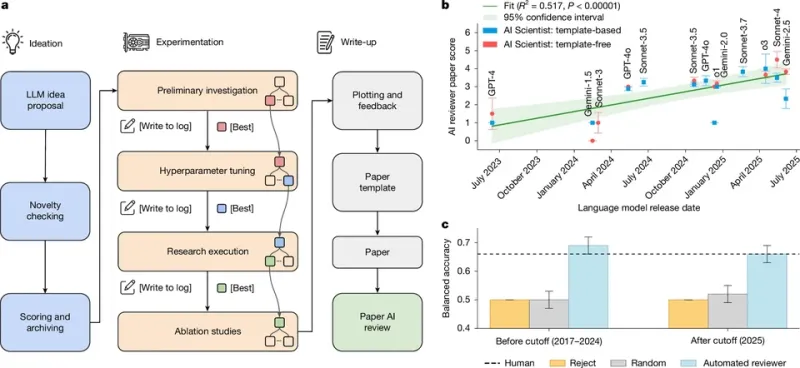
Photo: Authors of the study: Chris Lu, Cong Lu, Robert Tjarko Lange, Yutaro Yamada, Shengran Hu, Jakob Foerster, David Ha & Jeff Clune, CC BY 4.0, via Wikimedia Commons
Multi-step LLM systems have moved from demos into operational infrastructure. A single request may now involve intent classification, retrieval, tool selection, argument construction, state updates, policy checks, and response synthesis. The user sees one answer. The system sees a trajectory. That difference matters because most evaluation programs still treat these systems like single-turn chatbots.
When a chatbot fails, the failure is often local: the answer is wrong, incomplete, or off-policy. When an agentic workflow fails, the failure is usually distributed. A retrieval step returns a stale policy document. A tool call passes a valid but semantically incorrect order ID. A state manager carries forward a previous customer's preference. The final response can be fluent, confident, and wrong. Nothing throws an exception. That is the core problem of agentic drift.
Why the Chatbot Evaluation Playbook Fails
Single-turn evaluation asks whether the final output matches expectations. That is necessary but not sufficient. In a multi-step workflow, a correct final answer may hide several near misses, and an incorrect answer may originate several steps earlier. If the retrieval step has an 8 percent miss rate, the planning step has a 5 percent tool-selection error rate, and the synthesis step has a 4 percent grounding error rate, the end-to-end success rate can fall well below what any individual component suggests.
Teams often discover this only after launch. During development, the happy path dominates test sets. The tools are stable, the documents are clean, and the state is fresh. In production, tools time out, schemas change, documents age, and sessions become long and messy. The agent does not collapse. It degrades. Users experience the degradation as inconsistency, not as a bug report.
Three Failure Surfaces in Agentic NLP
The first surface is tool-call reliability. A tool call can be syntactically valid and still wrong. The JSON schema passes, the API accepts the request, and the result is irrelevant because the argument referenced the wrong entity. Traditional monitoring sees a 200 response. The agent sees a result. The user sees a bad answer. Reliable agent evaluation must check semantic validity, not just schema validity.
The second surface is state management. Multi-step agents accumulate context: user preferences, intermediate conclusions, tool outputs, and prior turns. Some systems truncate aggressively, some append without pruning, and some rely on model memory that is not actually durable. State drift occurs when the agent acts on a value that was true earlier but is no longer true, or when two sources of truth conflict. The final answer may be internally coherent while being operationally wrong.
The third surface is error propagation. One bad intermediate result can poison every downstream step. If the retrieval layer returns an outdated refund policy, the planning layer may choose the wrong remediation path, and the synthesis layer may explain it persuasively. The problem is not that the model hallucinated. The problem is that the workflow gave it bad material and no mechanism to detect the contradiction.
Instrument the Steps, Not Just the Final Answer
Step-level instrumentation starts with a trace model. Every request should produce a trace that records the step name, input summary, tool name, tool arguments, tool result summary, validation outcome, state changes, latency, and any confidence signal available. The trace should be correlated with a session ID and a model version. Without that, postmortems become storytelling.
Teams should also maintain golden trajectories, not only golden answers. A golden trajectory describes the expected sequence of steps and the acceptable range of intermediate results. For example, a support agent handling a damaged-item claim should retrieve the return policy, verify the order status, check the customer tier, and only then propose a refund or replacement. If the trace shows a refund proposal before the order status check, the system has a policy-compliance problem even if the final answer happens to be correct.
Per-step assertions are practical. Assert that tool arguments reference entities present in the current session. Assert that retrieved documents meet a freshness threshold. Assert that state values do not conflict with newer tool results. Assert that the final answer cites only sources that appeared in the retrieval trace. These checks do not require a perfect evaluator model. They require clear operational contracts.
Failure Budgets Make Drift Visible
Site reliability engineering popularized error budgets for infrastructure. Agentic workflows need something similar: failure budgets for semantic and procedural reliability. A team might set a 98 percent semantic tool-call accuracy target, a 99.5 percent state-consistency target, and a 95 percent trajectory-compliance target for a high-stakes workflow. These are not vanity metrics. They are thresholds that determine when the team stops shipping and starts investigating.
Failure budgets should distinguish recoverable errors from terminal ones. A tool timeout that triggers a retry may be recoverable. A wrong customer identity passed to a billing tool is terminal. Terminal errors should consume budget faster and trigger immediate review. Recoverable errors can be tracked separately so that normal network noise does not mask semantic drift.
Burn-rate alerts are more useful than static thresholds. If a workflow is consuming its monthly failure budget at three times the expected rate, the team needs to know today, not at the end of the quarter. This is especially important for agents that operate across many tools and document collections, where drift can emerge from a single upstream change.
Operational Practices That Catch Drift Early
Production agents need synthetic probes that exercise real tools in non-production environments. They need replay tests that run historical traces against new model versions. They need shadow traffic that compares the current agent against a candidate without exposing users to the candidate. They need human review samples drawn from long sessions, failed tool calls, and low-confidence trajectories, not just random final answers.
Version pinning matters. A model upgrade, a tool schema change, or a retrieval index refresh can alter agent behavior. Treat each as a release event with its own regression suite. Contract tests should verify that tools return the expected fields and that the agent handles missing fields gracefully.
Agentic drift is not a mysterious property of large language models. It is the predictable result of composing fallible steps without observing the seams. Teams that instrument the trajectory, define step-level budgets, and review failures at the workflow level will catch drift while it is still a metric. Teams that evaluate only the final answer will catch it when users do.