Beyond the Chatbot Era: How Transformer Models Are Redefining Enterprise Customer Service
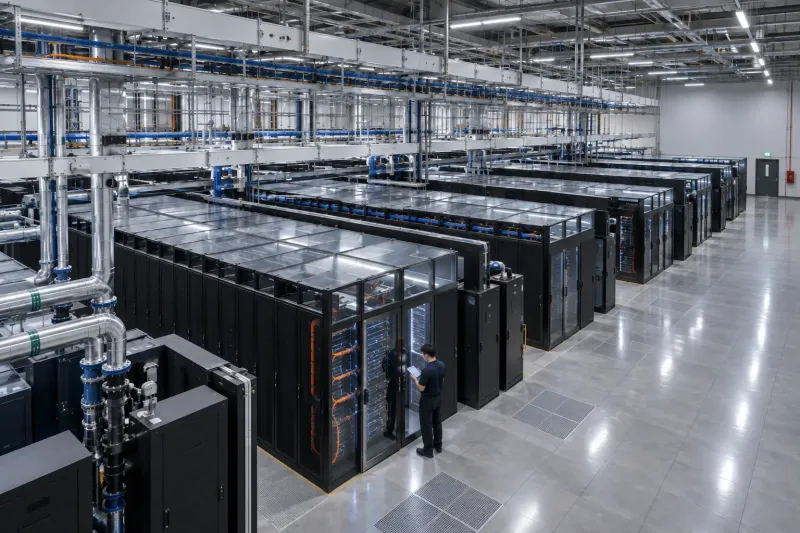
Photo: enterprise AI customer service agent transformer technology data center, via www.azuraconsultancy.com
For years, the dominant narrative around AI in customer service centered on chatbots: rule-based, decision-tree-driven systems that answered FAQs and routed tickets. That era is not simply evolving—it is being replaced. Transformer-based language models, refined through years of pretraining on massive corpora and fine-tuned on domain-specific datasets, are now capable of sustaining multi-turn conversations, inferring unstated customer intent, and generating contextually coherent responses that bear little resemblance to the canned replies of a decade ago.
The shift carries significant implications for US enterprises. Customer expectations have risen sharply, driven in part by consumer familiarity with large language model (LLM) interfaces in everyday life. Organizations that deploy legacy systems risk a measurable gap between what customers experience in their personal lives and what they encounter when contacting a brand.
What Makes Transformer-Based Systems Fundamentally Different
The architectural distinction matters here. Traditional intent-classification pipelines treated each customer utterance as an isolated signal, mapping it to a predefined label and triggering a scripted response. Transformer models, by contrast, encode the full conversational history into a continuous representation, allowing the system to track topic shifts, resolve pronoun references, and adjust tone based on sentiment cues embedded earlier in the exchange.
Consider a practical scenario: a customer contacts a telecommunications provider to dispute a charge but, midway through the conversation, pivots to asking about an upgrade. A legacy system typically requires a hard handoff or a fresh intent classification. A transformer-based system maintains the billing context while simultaneously handling the upgrade inquiry, reducing the need for customers to repeat themselves—one of the most consistently cited frustrations in US consumer satisfaction surveys.
Beyond conversational coherence, retrieval-augmented generation (RAG) architectures have extended these capabilities further. By coupling a language model with a dynamic knowledge base—product catalogs, policy documents, live account data—enterprises can ground model outputs in factual, up-to-date information rather than relying solely on parametric knowledge baked in at training time.
Deployment Realities: Latency, Accuracy, and the Production Gap
The gap between a compelling proof-of-concept and a stable production deployment is where many enterprise AI initiatives stall. Transformer models, particularly those operating at the scale of GPT-4-class architectures or open-weight equivalents like LLaMA 3, introduce latency profiles that are incompatible with real-time customer service expectations unless carefully managed.
A mid-market e-commerce retailer based in the Midwest, for example, piloted a 70-billion-parameter open-weight model for customer service automation in late 2024. Initial benchmark accuracy on their internal evaluation set was strong—above 91 percent on intent resolution tasks. However, median response latency exceeded 4.2 seconds under moderate load, a figure that internal UX research correlated with measurable cart abandonment increases in chat-based commerce flows.
The resolution involved a tiered inference strategy: a smaller, distilled model handles initial triage and common-case responses, while the full-scale model is reserved for complex, escalation-prone conversations. This pattern—sometimes called speculative or cascaded inference—has become a practical standard in US enterprise deployments where cost and latency constraints are non-negotiable.
For Fortune 500 organizations operating contact centers at scale, the calculus shifts. A major US retail bank deploying transformer-based NLP across its customer service channels reported that fine-tuning a domain-specific model on 18 months of anonymized interaction transcripts reduced hallucination rates on policy-related queries by approximately 34 percent compared to a zero-shot baseline. The investment in fine-tuning infrastructure was justified not by accuracy gains alone, but by the reduction in downstream human escalation costs.
Organizational Challenges Beyond the Technical Stack
Technology selection is only one dimension of a successful deployment. US enterprises consistently encounter organizational friction that proves equally consequential. Customer service teams accustomed to deterministic, auditable workflows often resist AI systems whose decision logic is not fully transparent. Compliance and legal teams in regulated industries—financial services, healthcare, insurance—require explainability mechanisms that standard transformer architectures do not natively provide.
Addressing this requires deliberate design choices. Logging intermediate reasoning steps, implementing confidence-score thresholds that trigger human review, and maintaining audit trails of model inputs and outputs are operational necessities rather than optional enhancements in regulated environments. Several US financial institutions have adopted a human-in-the-loop model where AI handles the first two turns of a conversation autonomously, with seamless escalation protocols that preserve full conversational context for the receiving agent.
Change management within customer service teams is an equally critical factor. Agents who perceive AI as a replacement rather than an augmentation tool are less likely to correct model errors, provide feedback, or engage with continuous improvement processes. Organizations that frame transformer deployments as collaborative—where agents serve as quality arbiters and the model handles volume—report higher adoption rates and more robust feedback loops.
Evaluation Frameworks That Actually Reflect Business Outcomes
One persistent gap in enterprise NLP deployments is the disconnect between model evaluation metrics and the business outcomes that actually matter. Accuracy on held-out test sets is a necessary but insufficient signal. Enterprises need evaluation frameworks that measure first-contact resolution rates, average handle time, customer satisfaction scores, and escalation frequency—metrics that connect model behavior to operational performance.
Building these frameworks requires investment in annotation pipelines, human evaluation protocols, and monitoring infrastructure. Shadow deployment—running a new model in parallel with the existing system and comparing outcomes before full cutover—has become a standard risk mitigation practice among US enterprises with mature ML operations.
The Road Ahead
As 2025 progresses, the competitive differentiation in enterprise customer service will increasingly hinge not on whether a company uses transformer-based NLP, but on how well it integrates those systems into coherent, contextually aware customer journeys. The organizations positioned to lead are those investing simultaneously in model quality, inference efficiency, evaluation rigor, and the organizational infrastructure to sustain continuous improvement.
The technology has matured sufficiently to deliver on its promise. The remaining work is largely operational—and that, in many respects, is the harder problem.